
12th English Quarterly Examination 2025 Solved Paper
Q.1. Read the passage and answer the questions that follow. [1×10=10]
The evening sun dipped low as Ramesh stepped onto the crowded platform of Gaya Junction. The station was alive with a thousand tiny movements — tea vendors calling out their prices, coolies rushing with luggage balanced on their heads, and passengers weaving in and out of the crowd. Ramesh’s train, bound for Kolkata, was scheduled to depart at 6:10 p.m., yet the announcement board glowed ominously with the words “Delayed – Expected at 9:30 p.m.” He sighed. His suitcase was heavy, but his thoughts weighed more. It had been three years since he last saw his mother, and the urgency in his uncle’s telegram — “Come immediately” — suggested time was short. Finding a corner seat on a worn wooden bench, Ramesh opened a small tiffin box and ate the last of the chapatis his neighbor had packed. As the hours passed, the platform transformed. Daylight faded into a flickering yellow from overhead lamps. Street dogs roamed between the tracks, scavenging for scraps. Vendors switched to selling hot pakoras and steaming cups of chai, their spicy aroma mingling with the smell of diesel. Finally, at 9:45 p.m., a deep rumble signaled the train’s arrival. It crept into the station like a weary beast, its windows glowing with dim light. Ramesh hurried aboard, finding a seat near the window. The whistle blew, and the train groaned forward. He stared out at the passing silhouettes of huts, trees, and distant fields. As the night deepened, Ramesh wondered if he would reach home in time. Outside, the darkness seemed endless, but inside, hope flickered like the train’s trembling lamp — fragile, yet stubbornly alive.
हिन्दी अनुवाद
साँझ का सूरज ढल चुका था जब रमेश गया जंक्शन के भीड़-भरे प्लेटफ़ॉर्म पर उतरा। स्टेशन हज़ारों छोटी-छोटी हलचलों से जीवंत था — चाय बेचने वाले अपनी कीमतें पुकार रहे थे, कुली सिर पर सामान लादे दौड़ रहे थे, और यात्री भीड़ के बीच इधर-उधर निकल रहे थे। रमेश की ट्रेन, जो कोलकाता जाने वाली थी, शाम 6:10 बजे छूटनी थी, लेकिन उद्घोषणा पट्ट पर डरावने अक्षरों में चमक रहा था — “देरी से — अपेक्षित समय 9:30 रात।”
रमेश ने गहरी साँस ली। उसका सूटकेस भारी था, पर उसके विचार उससे भी भारी थे। उसे अपनी माँ को देखे हुए पूरे तीन साल हो चुके थे, और उसके चाचा के तार का संक्षिप्त संदेश — “तुरंत आओ” — बता रहा था कि समय बहुत कम है।
एक जर्जर लकड़ी की बेंच पर कोने की सीट पाकर रमेश ने छोटा टिफ़िन खोला और अपने पड़ोसी द्वारा दिए गए आख़िरी रोटियाँ खा लीं। घंटे बीतते गए और प्लेटफ़ॉर्म का रूप बदलता गया। दिन का उजाला ऊपर लगे पीले टिमटिमाते लैम्पों में बदल गया। आवारा कुत्ते पटरियों के बीच भटकते हुए खाने की तलाश करने लगे। खोमचे वाले अब गरम पकौड़े और भाप उड़ाती चाय बेचने लगे, जिनकी मसालेदार खुशबू डीज़ल की गंध के साथ घुलने लगी।
आख़िरकार, रात 9:45 बजे गहरी गड़गड़ाहट के साथ ट्रेन के आने का संकेत मिला। वह स्टेशन में ऐसे घुसी जैसे कोई थका हुआ पशु, जिसकी खिड़कियाँ मंद रोशनी से चमक रही थीं। रमेश जल्दी से डिब्बे में चढ़ा और खिड़की के पास एक सीट पा ली। सीटी बजी और ट्रेन कराहते हुए आगे बढ़ी।
वह बाहर झोपड़ियों, पेड़ों और दूर-दूर तक फैले खेतों की परछाइयों को देखता रहा। रात गहराती गई, और रमेश सोचता रहा कि क्या वह समय पर घर पहुँच पाएगा। बाहर अंधेरा अनंत सा लग रहा था, लेकिन भीतर आशा टिमटिमाती रही — बिल्कुल वैसे ही जैसे ट्रेन का काँपता हुआ लैम्प — नाज़ुक, पर जिद्दी होकर ज़िंदा।
Passage Explanation (हिंदी और English में)
English Explanation:
This passage describes Ramesh’s journey at Gaya Junction. His train to Kolkata was supposed to leave at 6:10 p.m., but it got delayed until 9:30 p.m. The platform was crowded with vendors, coolies, and passengers. As time passed, the platform changed: daylight faded, lamps glowed, dogs wandered, and vendors sold pakoras and tea. Finally, the train arrived at 9:45 p.m. Ramesh boarded, worried if he would reach home in time because his uncle’s telegram said, “Come immediately.” He had not seen his mother in three years. The flickering lamp inside the train symbolized his fragile yet stubborn hope.
Hindi Explanation (सारांश):
यह गद्यांश रमेश की यात्रा का वर्णन करता है। रमेश गया जंक्शन स्टेशन पर पहुँचता है। उसकी ट्रेन कोलकाता के लिए शाम 6:10 बजे रवाना होनी थी, लेकिन यह 9:30 बजे तक लेट हो गई। प्लेटफ़ॉर्म पर चायवाले, कुली और यात्री भीड़ में व्यस्त थे। समय बीतने के साथ दृश्य बदल गया — उजाला ख़त्म होकर लैंप जल उठे, कुत्ते इधर-उधर भटक रहे थे और दुकानदार पकौड़े व चाय बेच रहे थे। रात 9:45 बजे ट्रेन आई और रमेश उसमें बैठ गया। उसके मन में चिंता थी कि क्या वह समय पर माँ से मिल पाएगा, क्योंकि चाचा के टेलीग्राम में लिखा था – “तुरंत आओ।” माँ को देखे हुए उसे तीन साल हो चुके थे। ट्रेन का टिमटिमाता दीपक उसकी कमज़ोर लेकिन जिद्दी आशा का प्रतीक था।
Questions & Answers with Full Explanation in Hindi + English
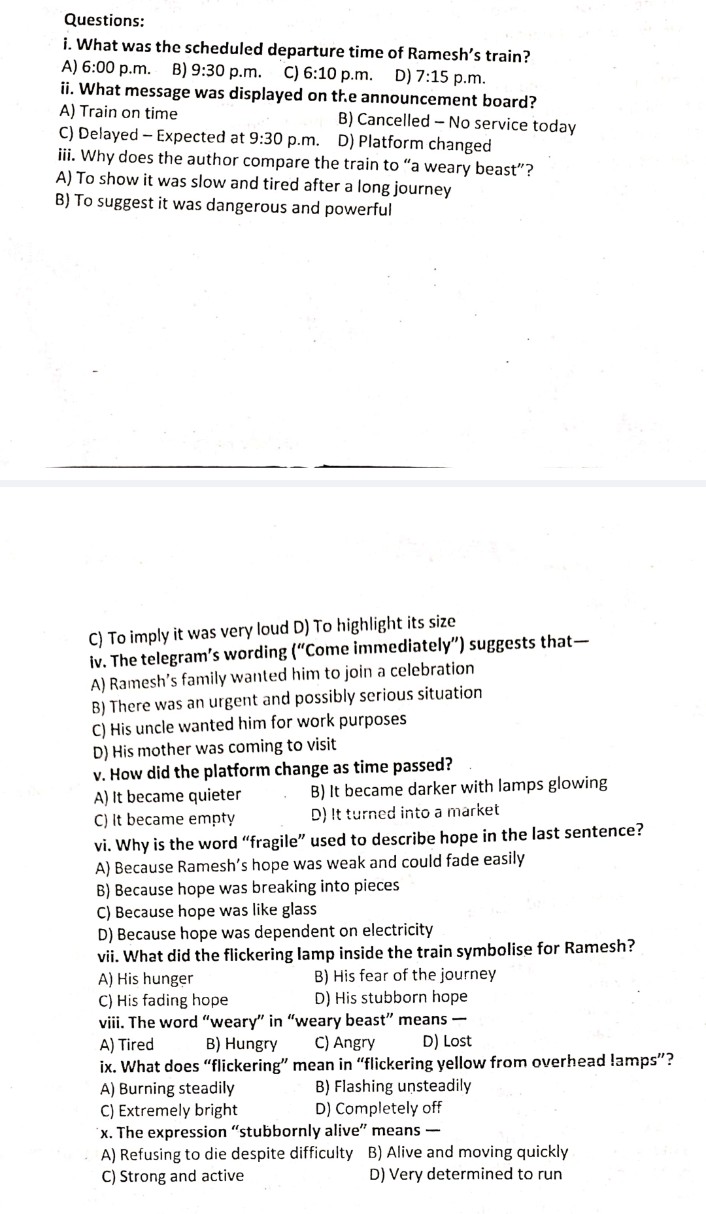
Q.1 (i) What was the scheduled departure time of Ramesh’s train?
- Answer: C) 6:10 p.m.
English Explanation of Question:
The question is asking the official time when Ramesh’s train was supposed to leave.
Hindi Explanation of Question:
यह प्रश्न पूछ रहा है कि रमेश की ट्रेन का निर्धारित (official) समय क्या था।
Answer Explanation (English):
The passage says the train was scheduled at 6:10 p.m.
Answer Explanation (Hindi):
गद्यांश में साफ़ लिखा है कि ट्रेन का समय शाम 6:10 बजे था।
Q.1 (ii) What message was displayed on the announcement board?
- Answer: C) Delayed – Expected at 9:30 p.m.
English Question Explanation:
This asks what the board showed about the train.
Hindi Question Explanation:
यह प्रश्न पूछ रहा है कि घोषणा पट्ट पर ट्रेन के बारे में क्या लिखा था।
Answer Explanation (English):
The board showed the train was delayed till 9:30 p.m.
Answer Explanation (Hindi):
घोषणा पट्ट पर लिखा था कि ट्रेन 9:30 बजे तक लेट है।
Q.1 (iii) Why does the author compare the train to “a weary beast”?
- Answer: A) To show it was slow and tired after a long journey.
English Question Explanation:
This asks the reason for the comparison of the train with a tired animal.
Hindi Question Explanation:
यह पूछ रहा है कि ट्रेन की तुलना थके हुए जानवर से क्यों की गई है।
Answer Explanation (English):
The train moved slowly and looked tired, like an exhausted beast.
Answer Explanation (Hindi):
ट्रेन बहुत धीमी और थकी हुई लग रही थी, जैसे कोई थका हुआ जानवर।
Q.1 (iv) The telegram’s wording (“Come immediately”) suggests that—
- Answer: B) There was an urgent and possibly serious situation.
English Question Explanation:
This asks what message “Come immediately” indicates.
Hindi Question Explanation:
यह पूछ रहा है कि “तुरंत आओ” से क्या संकेत मिलता है।
Answer Explanation (English):
It means there was urgency and something serious at home.
Answer Explanation (Hindi):
इसका अर्थ है कि घर पर कोई गंभीर स्थिति थी।
Q.1 (v) How did the platform change as time passed?
- Answer: B) It became darker with lamps glowing.
English Question Explanation:
This asks what happened to the platform when evening turned to night.
Hindi Question Explanation:
यह पूछ रहा है कि शाम से रात होते समय प्लेटफ़ॉर्म पर क्या बदलाव हुआ।
Answer Explanation (English):
The platform got dark and lamps started glowing.
Answer Explanation (Hindi):
प्लेटफ़ॉर्म पर अंधेरा छा गया और लैंप जल उठे।
Q.1 (vi) Why is the word “fragile” used to describe hope in the last sentence?
- Answer: A) Because Ramesh’s hope was weak and could fade easily.
English Question Explanation:
The question asks why the writer used the word fragile (delicate/weak) for hope.
Hindi Question Explanation:
यह प्रश्न पूछ रहा है कि लेखक ने “fragile” (नाज़ुक/कमज़ोर) शब्द का प्रयोग आशा के लिए क्यों किया।
Answer Explanation (English):
Ramesh’s hope was not strong. It could break or disappear any moment.
Answer Explanation (Hindi):
रमेश की आशा बहुत कमज़ोर और टूटने वाली थी। यह कभी भी खत्म हो सकती थी।
Q.1 (vii) What did the flickering lamp inside the train symbolise for Ramesh?
- Answer: D) His stubborn hope.
English Question Explanation:
This asks what meaning the flickering lamp had for Ramesh.
Hindi Question Explanation:
यह प्रश्न पूछ रहा है कि ट्रेन का टिमटिमाता दीपक रमेश के लिए किसका प्रतीक था।
Answer Explanation (English):
The lamp symbolized his hope, weak but still alive.
Answer Explanation (Hindi):
वह दीपक उसकी कमज़ोर लेकिन जिद्दी आशा का प्रतीक था।
Q.1 (viii) The word “weary” in “weary beast” means —
- Answer: A) Tired.
English Question Explanation:
This asks the meaning of the word weary used in the passage.
Hindi Question Explanation:
यह प्रश्न गद्यांश में आए शब्द “weary” का अर्थ पूछ रहा है।
Answer Explanation (English):
“Weary” means tired or exhausted.
Answer Explanation (Hindi):
“Weary” का अर्थ है थका हुआ / श्रांत।
Q.1 (ix) What does “flickering” mean in “flickering yellow from overhead lamps”?
- Answer: B) Flashing unsteadily.
English Question Explanation:
This asks the meaning of the word flickering in the context of lamps.
Hindi Question Explanation:
यह प्रश्न पूछ रहा है कि “flickering” का अर्थ लैंप के संदर्भ में क्या है।
Answer Explanation (English):
“Flickering” means light that shines unsteadily, like going on and off.
Answer Explanation (Hindi):
“Flickering” का मतलब है रोशनी का टिमटिमाना / अनियमित रूप से जलना।
Q.1 (x) The expression “stubbornly alive” means —
- Answer: A) Refusing to die despite difficulty.
English Question Explanation:
This asks what the phrase “stubbornly alive” means.
Hindi Question Explanation:
यह प्रश्न पूछ रहा है कि “stubbornly alive” का क्या अर्थ है।
Answer Explanation (English):
It means something continues to live or survive even when it is very weak.
Answer Explanation (Hindi):
इसका अर्थ है कि कोई चीज़ बहुत कठिनाई के बावजूद भी मरने से इंकार कर रही हो और जीवित बनी रहे।
Q.2. Read the passage carefully and make notes on it. Also give a suitable title.
The internet is perhaps the most transformative invention of the modern era. It has revolutionized communication, learning, and business. With a single click, we can access vast amounts of information, connect with people across the globe, and conduct transactions from the comfort of our homes. Educational resources, online courses, and digital libraries have made learning accessible to anyone with an internet connection. Businesses thrive through e-commerce, while social media platforms allow individuals to share ideas and experiences instantly. However, the internet is not without drawbacks. Overuse can lead to addiction, reduced attention spans, and a decline in face-to-face communication. It is also a breeding ground for misinformation, cyberbullying, and security threats. Privacy concerns are rising as personal data is often collected and misused. Therefore, the internet can be both a boon and a bane, depending on how it is used. The solution lies in striking a balance—using it as a tool for learning, productivity, and meaningful connection while avoiding harmful overdependence. Ultimately, the internet’s value depends on the responsibility of its users.
हिन्दी अनुवाद
इंटरनेट शायद आधुनिक युग का सबसे परिवर्तनकारी आविष्कार है। इसने संचार, शिक्षा और व्यापार की दुनिया को पूरी तरह बदल दिया है। केवल एक क्लिक में हम अपार जानकारी प्राप्त कर सकते हैं, दुनिया भर के लोगों से जुड़ सकते हैं और अपने घर के आराम से लेन-देन कर सकते हैं। शैक्षणिक संसाधन, ऑनलाइन पाठ्यक्रम और डिजिटल पुस्तकालय ने शिक्षा को हर उस व्यक्ति तक पहुँचा दिया है जिसके पास इंटरनेट की सुविधा है। व्यापार ई-कॉमर्स के माध्यम से फल-फूल रहा है, वहीं सोशल मीडिया प्लेटफ़ॉर्म लोगों को तुरंत विचार और अनुभव साझा करने का अवसर देते हैं।
हालाँकि, इंटरनेट की कुछ कमियाँ भी हैं। अत्यधिक उपयोग लत, एकाग्रता में कमी और आमने-सामने संवाद में गिरावट का कारण बन सकता है। यह गलत जानकारी, साइबर बुलिंग और सुरक्षा खतरों का भी केंद्र बन गया है। गोपनीयता की चिंताएँ बढ़ रही हैं क्योंकि व्यक्तिगत डेटा अक्सर एकत्रित और दुरुपयोग किया जाता है।
इसलिए, इंटरनेट एक वरदान भी हो सकता है और अभिशाप भी—यह इस बात पर निर्भर करता है कि इसका उपयोग कैसे किया जाता है। समाधान संतुलन बनाने में है—इसे शिक्षा, उत्पादकता और सार्थक जुड़ाव का साधन बनाकर, हानिकारक निर्भरता से बचते हुए उपयोग करना चाहिए। अंततः, इंटरनेट का मूल्य उसके उपयोगकर्ताओं की जिम्मेदारी पर निर्भर करता है।
Answer:
- The Role of Internet in Modern Life
- Internet: A Boon and a Bane
- Impact of Internet on Education and Society
- Internet – Uses and Abuses
- The Double-Edged Sword: Internet
- Advantages and Disadvantages of Internet
- Internet – A Powerful Tool
- Internet: Blessing or Curse
- Internet – Revolution in Communication
- Responsible Use of Internet
Title:
👉 The Internet – Boon or Bane
Notes:
- Internet – A Transformative Invention
- Revolutionized communication, learning & business
- Provides vast info with a single click
- Connects people globally
- Educational Benefits
- Online courses, digital libraries
- Learning accessible anywhere
- Business & Social Media
- Growth through e-commerce
- Platforms for sharing ideas instantly
- Drawbacks
- Overuse → addiction, less face-to-face talk
- Misinformation, cyberbullying, security threats
- Privacy issues (misuse of personal data)
- Conclusion
- Internet can be boon or bane
- Value depends on responsible use
Explanation in English:
The question asks us to make short, organized notes from the given passage about the internet. We also have to write a suitable title. Notes should cover benefits, drawbacks, and conclusion.
Explanation in Hindi:
यह प्रश्न हमसे कहता है कि दिए गए गद्यांश (Internet पर) से संक्षिप्त व व्यवस्थित नोट्स बनाइए। साथ ही एक उपयुक्त शीर्षक दीजिए। नोट्स में इंटरनेट के लाभ, हानियाँ और निष्कर्ष शामिल होना चाहिए।
Q.3 (Option 1) – Poster Writing
Question:
Your local community center is organizing a Blood Donation Camp. Prepare a poster inviting people to participate.
Answer (Poster):
BLOOD DONATION CAMP 🩸
“Donate Blood – Save a Life”
📍 Venue: Community Center Hall, Nehru Nagar
📅 Date: Sunday, 15th October 2025
⏰ Time: 10:00 a.m. – 4:00 p.m.
👉 Organized by: Nehru Nagar Community Center
👉 Facilities: Free health check-up, Refreshments for donors
Be a Hero – Your Blood Can Give Someone a New Life!
(For details, contact: 9876543210)
Explanation (English):
The question asks us to design a poster for a blood donation camp. A poster must be attractive, brief, and informative. It should have –
- A catchy title/slogan
- Date, Time, Venue
- Organizers’ name
- Contact information
- Motivating lines to encourage people
Explanation (Hindi):
यह प्रश्न हमें रक्तदान शिविर के लिए एक पोस्टर बनाने को कहता है। पोस्टर हमेशा आकर्षक, छोटा और सूचनाप्रद होना चाहिए। इसमें होना चाहिए –
- आकर्षक शीर्षक/स्लोगन
- तिथि, समय और स्थान
- आयोजक का नाम
- संपर्क जानकारी
- प्रेरक पंक्तियाँ
Q.3 (Option 2) – Notice Writing
Question:
As the Head Boy/Head Girl of your school, draft a notice inviting students to participate in an Inter-School Debate Competition to be held in your school auditorium.
Answer (Notice):
St. Xavier’s Sr. Sec. School, Bhopal
NOTICE
📅 Date: 10th September 2025
Inter-School Debate Competition
All students are hereby informed that our school is organizing an Inter-School Debate Competition in the school auditorium.
📍 Venue: School Auditorium
📅 Date: 20th September 2025
⏰ Time: 11:00 a.m. onwards
👉 Interested students may give their names to the undersigned by 15th September.
👉 Topic of Debate: “Social Media – A Boon or a Curse?”
(Head Boy/Head Girl)
Explanation (English):
A notice should be formal and precise. It includes –
- Name of institution
- Word “NOTICE”
- Date
- Heading
- Details of event (what, when, where)
- Instructions to participants
- Signature/designation
Explanation (Hindi):
सूचना (Notice) हमेशा औपचारिक और संक्षिप्त होती है। इसमें होना चाहिए –
- संस्था का नाम
- “NOTICE” शब्द
- तिथि
- शीर्षक
- कार्यक्रम का विवरण (क्या, कब, कहाँ)
- विद्यार्थियों के लिए निर्देश
- हस्ताक्षर/पदनाम
Q.4 (Option 1) – Complaint Letter
Question:
You are Rohit Sharma, 22, Nehru Nagar, Bhopal. Write a letter to the SDM of your area complaining about the use of loudspeakers at night during religious and social functions, which disturbs students and elderly people.
Answer (Complaint Letter):
22, Nehru Nagar
Bhopal
15th September, 2025
To,
The Sub-Divisional Magistrate,
Bhopal.
Subject: Complaint regarding the use of loudspeakers at night
Respected Sir,
I am a resident of Nehru Nagar, Bhopal. I would like to draw your kind attention to the excessive use of loudspeakers during religious and social functions in our area. These loudspeakers are often played late into the night, causing a lot of disturbance.
This constant noise has made it very difficult for students to study and for elderly people to sleep. It is affecting the health and peace of the entire locality.
I request you to kindly take strict action to restrict the use of loudspeakers beyond permissible hours and ensure peace in the neighborhood.
Thanking you,
Yours faithfully,
Rohit Sharma
Explanation (English):
The question asks for a formal complaint letter. Such letters must include –
- Address of sender
- Date
- Receiver’s designation
- Subject line
- Formal body (problem + effect + request)
- Polite closing & signature
Explanation (Hindi):
यह प्रश्न एक शिकायत पत्र लिखने को कहता है। ऐसे पत्र में होना चाहिए –
- प्रेषक का पता
- तिथि
- प्राप्तकर्ता का पद/पता
- विषय पंक्ति
- मुख्य भाग (समस्या + प्रभाव + निवेदन)
- विनम्र समापन और हस्ताक्षर
Q.4 (Option 2) – Invitation Letter to Friend
Question:
You are Rahul Jain, residing 17, Tilak Nagar, Bhopal. Write a letter to your friend inviting him to spend the winter vacation with you.
Answer (Informal Letter):
17, Tilak Nagar
Bhopal
15th September, 2025
My dear Friend,
I hope you are fine and doing well in your studies. Our winter vacation is about to begin, and I would like to invite you to spend the holidays with me at my home in Bhopal.
We will enjoy our time together by visiting interesting places like Van Vihar, Upper Lake, and Bharat Bhavan. We can also study together and prepare for the coming examinations. My parents are also eager to meet you.
Please confirm your visit soon so that I can make arrangements. I am sure this vacation will be memorable for both of us.
With love,
Yours sincerely,
Rahul Jain
Explanation (English):
This is an informal invitation letter written to a friend. It should be friendly in tone. Key features –
- Friendly salutation (“My dear Friend”)
- Warm invitation
- Mention of plans/activities
- Closing with affection
Explanation (Hindi):
यह एक अनौपचारिक आमंत्रण पत्र है, जो मित्र को लिखा गया है। इसमें भाषा सरल और दोस्ताना होनी चाहिए। मुख्य बिंदु –
- दोस्ताना संबोधन (“प्रिय मित्र”)
- छुट्टियों में आने का निमंत्रण
- साथ करने वाली गतिविधियों का ज़िक्र
- स्नेहपूर्ण समापन
Q.5 (Option 1 – Article Writing)
Question: Write an article on any one of the following topics in about 120 words:
(a) Importance of Sports and Games in Student Life
(b) Online Education – Boon or Bane?
(c) Benefits of Modern Technology
Answer:
(a) Importance of Sports and Games in Student Life
Sports and games play a very important role in student life. They help in the overall development of body and mind. A healthy body is necessary for a sharp brain, and games keep us physically fit. They also teach discipline, teamwork, cooperation, and time management. Students who play games regularly learn the value of hard work and fair play. Sports are also a good way to release stress and refresh the mind after studies. Participation in games builds confidence and leadership qualities. In short, sports and games are not just for entertainment but are essential for success in student life. Therefore, every student should take part in some sport for a balanced life.
(b) Online Education – Boon or Bane?
Online education has become very popular in recent years. It provides learning opportunities to students from anywhere through the internet. With digital platforms, one can attend classes, watch lectures, and use online libraries at home. It saves time and money, making education more accessible. However, it also has drawbacks. Too much screen time can harm health and reduce concentration. Some students misuse online freedom, and poor internet connection creates problems. Face-to-face interaction with teachers and friends also decreases. Thus, online education can be both a boon and a bane. It depends on how students use it. If used wisely, it can be a powerful tool for learning in the modern world.
(c) Benefits of Modern Technology
Modern technology has made our lives fast, easy, and comfortable. It has changed the way we live, work, and communicate. Mobile phones, computers, and the internet have connected people across the world. Machines and modern tools have made industries more productive. In education, technology provides smart classes, online courses, and e-books. In medicine, modern equipment saves lives through better diagnosis and treatment. Even in daily life, we use technology in cooking, traveling, and shopping. However, its misuse can create problems like laziness and overdependence. Overall, modern technology is a great gift to humanity. If used properly, it can lead society towards progress and a better future.
Explanation (English):
This is an article so it must have –
- Title
- Introduction (importance)
- Body (benefits & examples)
- Conclusion (suggestion/moral)
Explanation (Hindi):
यह एक लेख (Article) है। इसमें होना चाहिए –
- शीर्षक
- परिचय (महत्त्व)
- मुख्य भाग (लाभ व उदाहरण)
- निष्कर्ष (सुझाव या सीख)
Q.5 (Option 2 – Report Writing)
Question: You are the Secretary of the Science Club. Write a report on the Science Exhibition conducted in your school (about 120 words).
Answer (Report):
Report on the Science Exhibition
By: Secretary, Science Club
Our school organized a Science Exhibition on 10th September 2025 in the school auditorium. The Chief Guest was Dr. A.K. Sharma, a renowned scientist. Students from all classes participated enthusiastically and displayed innovative projects and working models.
The main attractions were a model of a solar-powered car, water purifier, and earthquake alarm. The exhibition was visited by parents, teachers, and students of nearby schools. The Chief Guest appreciated the creativity and hard work of the participants.
The event was a grand success. It not only developed scientific temperament among students but also encouraged them to think creatively. The exhibition concluded with a vote of thanks by the Principal.
Explanation (English):
This is a report, so it should be factual and in past tense. Structure –
- Title
- Intro (when, where, chief guest)
- Body (participation, special attractions)
- Conclusion (outcome)
Explanation (Hindi):
यह एक रिपोर्ट है, जिसे हमेशा तथ्यात्मक और भूतकाल (past tense) में लिखा जाता है। संरचना –
- शीर्षक
- परिचय (कब, कहाँ, मुख्य अतिथि)
- मुख्य भाग (भागीदारी, विशेष आकर्षण)
- निष्कर्ष (परिणाम)
Q.6. Fill in the blanks (Any five)
(i) I met ___ European tourist at the museum. (a / an / the)
- Answer: a
- Hint: “European” starts with a consonant sound (यूरो…), not a vowel sound.
English Explanation:
We use “a” before words beginning with a consonant sound. Here “European” sounds like “yoo…”, so we use “a”.
Hindi Explanation:
“European” का उच्चारण यूरोपियन है, जो व्यंजन ध्वनि (ya) से शुरू होता है। इसलिए “an” नहीं, “a” लगेगा।
(ii) She has ___ friends in this city. (any / little / many)
- Answer: many
- Hint: “Friends” is plural countable, so “many” is correct.
English Explanation:
We use “many” with plural countable nouns.
Hindi Explanation:
“Friends” (दोस्त) गिनने योग्य और बहुवचन है, इसलिए “many” सही है।
(iii) The train will arrive ___ 5 p.m. (in / on / at)
- Answer: at
- Hint: For exact time, we always use “at”.
English Explanation:
We use “at” with exact clock times.
Hindi Explanation:
सटीक समय (जैसे 5 बजे) बताने के लिए हमेशा “at” प्रयोग करते हैं।
(iv) The train ___ when we reached the station. (leaves / left / had left)
- Answer: had left
- Hint: One past action (train leaving) happened before another past action (we reached).
English Explanation:
Past Perfect (“had left”) is used for the earlier past action.
Hindi Explanation:
दो बीती घटनाओं में से जो पहले हुई (train निकल गई), उसके लिए Past Perfect (had left) का प्रयोग होता है।
(v) She has been living in Delhi ___ 2015. (for / since / from)
- Answer: since
- Hint: Use “since” with a point of time (2015).
English Explanation:
“Since” is used for the starting point of time.
Hindi Explanation:
“Since” का प्रयोग तब होता है जब समय की शुरुआत बतानी हो, जैसे 2015 से।
(vi) He is junior ___ me in service. (than / to / from)
- Answer: to
- Hint: Words like junior, senior, inferior, superior always take “to”.
English Explanation:
We say “junior to”, “senior to”, not “than”.
Hindi Explanation:
“Junior, senior, inferior, superior” जैसे शब्दों के बाद हमेशा “to” आता है।
(vii) You can stay here ___ you like. (unless / if / so)
- Answer: if
- Hint: The sentence means “You may stay here provided you like.” → condition → if.
English Explanation:
We use “if” to show condition.
Hindi Explanation:
शर्त बताने के लिए “if” प्रयोग होता है।
Q.7. Do as directed (any five)
(i) She hid my pen. (Change into Negative)
- Answer: She did not hide my pen.
- Hint: Use “did not” for past tense negative.
English Explanation:
The sentence is in Past Simple → Negative form = Subject + did not + V¹.
Hindi Explanation:
वाक्य Past Simple (छुपाया) में है। इसका Negative: Subject + did not + Verb¹.
(ii) He writes a letter. (Change the Voice)
- Answer: A letter is written by him.
- Hint: Present Simple → passive form = Object + is/are + V³.
English Explanation:
Active: He writes a letter. → Passive: A letter is written by him.
Hindi Explanation:
Active: He writes a letter. (वह पत्र लिखता है) → Passive: पत्र उसके द्वारा लिखा जाता है।
(iii) She said, “Anupam works very hard.” (Change the Narration)
- Answer: She said that Anupam worked very hard.
- Hint: Reporting verb in past → change present tense to past tense.
English Explanation:
Direct: She said, “Anupam works…” → Indirect: She said that Anupam worked…
Hindi Explanation:
Direct में Present Simple था (“works”), Indirect में यह Past Simple (“worked”) हो गया।
(iv) The teacher explains the lesson. (Change the Voice)
- Answer: The lesson is explained by the teacher.
- Hint: Present Simple → passive = Object + is/are + V³.
English Explanation:
Active: The teacher explains the lesson → Passive: The lesson is explained by the teacher.
Hindi Explanation:
Active: शिक्षक पाठ समझाते हैं → Passive: पाठ शिक्षक द्वारा समझाया जाता है।
(v) This is the man. The man stole your watch. (Combine into Relative Clause)
- Answer: This is the man who stole your watch.
- Hint: Use “who” for persons.
English Explanation:
We join the two sentences using a relative pronoun “who”.
Hindi Explanation:
दोनों वाक्यों को “who” (जो) से जोड़ दिया → “यह वही आदमी है जिसने तुम्हारी घड़ी चुराई।”
(vi) I wanted to go outside. It was raining. (Rewrite using ‘but’)
- Answer: I wanted to go outside but it was raining.
- Hint: “But” is used to show contrast.
English Explanation:
The two opposite ideas (wanted to go vs. raining) are joined with “but”.
Hindi Explanation:
दो विपरीत विचारों (बाहर जाना चाहता था + बारिश हो रही थी) को “but” से जोड़ा।
(vii) If you don’t hurry, you will miss the train. (Rewrite using ‘unless’)
- Answer: Unless you hurry, you will miss the train.
- Hint: “Unless” = if…not.
English Explanation:
Unless means “if not”. So “If you don’t hurry” = “Unless you hurry”.
Hindi Explanation:
“Unless” का मतलब होता है “अगर नहीं”। इसलिए “If you don’t hurry” = “Unless you hurry”.
Q.8. Read the following passage carefully and answer the questions given below [5]
“My children, this is the last lesson I shall give you. The order has come from Berlin to teach only German in the schools of Alsace and Lorraine. The new master comes tomorrow. This is your last French lesson. I want you to be very attentive. What a thunderclap these words were to me! Oh, the wretches; that was what they had put up at the town-hall! My last French lesson! Why, I hardly knew how to write! I should never learn anymore! I must stop there, then! Oh, how sorry I was for not learning my lessons, for seeking birds’ eggs, or going sliding on the Saar! My books, that had seemed such a nuisance a while ago, so heavy to carry, my grammar, and my history of the saints, were old friends now that I could not give up.”
Q.8 Questions and Answers
(i) Who made the announcement about the “last lesson”?
- Answer: B) M. Hamel
Hint: The teacher of French, M. Hamel, informed the class.
English Explanation:
The announcement was made by M. Hamel, the French teacher, not by Franz or others.
Hindi Explanation:
यह घोषणा M. Hamel (फ्रेंच शिक्षक) ने की थी, न कि फ्रांज़ या किसी और ने।
(ii) Why was this the last French lesson?
- Answer: C) An order from Berlin mandated teaching German.
Hint: Berlin had ordered German to be taught in Alsace and Lorraine.
English Explanation:
The order from Berlin forced all schools in Alsace and Lorraine to stop French and start teaching German.
Hindi Explanation:
बर्लिन से आदेश आया था कि अब एल्सास और लोरेन के स्कूलों में फ्रेंच नहीं, केवल जर्मन पढ़ाई जाएगी।
(iii) What was Franz’s immediate reaction to the announcement?
- Answer: C) He was shocked and regretful.
Hint: Franz felt sorry for wasting time earlier.
English Explanation:
Franz regretted not learning his lessons, and he felt deep shock on hearing the news.
Hindi Explanation:
फ्रांज़ को बहुत पछतावा हुआ कि उसने पहले पढ़ाई में ध्यान नहीं दिया और वह इस खबर से चौंक गया और दुखी हुआ।
(iv) Which activity did Franz regret doing instead of learning his lessons?
- Answer: B) Seeking birds’ eggs and sliding on the Saar.
Hint: He wasted time in play instead of studying.
English Explanation:
Franz regretted running after birds’ eggs and sliding on the Saar river instead of learning.
Hindi Explanation:
फ्रांज़ को पछतावा हुआ कि उसने पढ़ाई करने के बजाय पंछियों के अंडे ढूँढने और सार नदी पर फिसलने में समय गंवाया।
(v) How did Franz’s attitude towards his books change after the announcement?
- Answer: C) He felt they were his old friends.
Hint: Earlier he found them boring, now he valued them.
English Explanation:
Franz, who earlier thought books were a nuisance, now felt they were like his best friends.
Hindi Explanation:
पहले फ्रांज़ को किताबें बोझ लगती थीं, पर अब वे उसे पुराने मित्र लगने लगीं।
Q.9 A – Poem (My Mother at Sixty-Six)
“Driving from my parent’s home to Cochin last Friday
morning, I saw my mother, beside me, doze, open mouthed, her face
ashen like that of a corpse and realized with pain that she was as old as she looked. But soon
put that thought away, and looked out at young trees sprinting, the merry children spilling
out of their homes.”
Questions & Answers
(i) What does the poet see outside the car window?
- Answer: B) Young trees sprinting.
Hint: The trees appear moving fast as the car moves.
English Explanation:
From the moving car, the poet sees young trees rushing past, symbolizing life and energy.
Hindi Explanation:
चलती कार से कवयित्री को तेज़ी से भागते हुए पेड़ दिखते हैं, जो जीवन और ऊर्जा का प्रतीक हैं।
(ii) What feeling does the sight of the mother evoke in the poet?
- Answer: C) Pain.
Hint: Her mother looked pale and old, which made the poet sad.
English Explanation:
Seeing her mother’s ashen face reminded the poet of mortality, filling her with pain.
Hindi Explanation:
माँ का पीला और बूढ़ा चेहरा देखकर कवयित्री को दुख और पीड़ा महसूस हुई।
(iii) The poem from which the above text has been taken is …
- Answer: A) My Mother at Sixty Six.
Hint: The extract is from Kamala Das’s poem.
English Explanation:
The extract is from the poem My Mother at Sixty-Six by Kamala Das.
Hindi Explanation:
यह अंश कमला दास की कविता “My Mother at Sixty-Six” से लिया गया है।
Q.9 B – Prose (The Third Level)
“There were brass spittoons on the floor, and across the room a small, curved glass window with gold lettering on it that said ‘The Globe Newspaper’. Men wore derby hats, black four- button suits with tiny lapels, and big black handlebar moustaches. I saw a man pulling a gold watch out of his vest pocket. The currency they used was old-style bills. And I never saw so many beards, sideburns, and fancy moustaches in my life. The station itself smelled of cigars and old wood. The clerks looked at me strangely when I tried to buy tickets to Galesburg with my modern notes. That was when I realized—I was really in 1894, standing on the third level.”
Questions & Answers
(i) What was written on the small, curved glass window in the third-level station?
- Answer: A) The Globe Newspaper.
Hint: The name of the newspaper was clearly mentioned.
English Explanation:
The window bore the gold lettering of The Globe Newspaper.
Hindi Explanation:
काँच की खिड़की पर “The Globe Newspaper” सुनहरे अक्षरों में लिखा था।
(ii) Which detail shows that the people belonged to an earlier time period?
- Answer: D) Both B and C (Men wearing derby hats and four-button suits + Brass spittoons).
Hint: These are old-fashioned things.
English Explanation:
The description of clothes and spittoons indicated the time was 1894.
Hindi Explanation:
लोगों के कपड़े (डर्बी हैट, पुराने सूट) और पीतल की थूकदानें साबित करती हैं कि यह पुराना ज़माना (1894) था।
(iii) Why did the clerks look strangely at Charley?
- Answer: C) He tried to pay with modern currency notes.
Hint: Old period had old-style currency.
English Explanation:
Charley offered modern notes in 1894, which surprised the clerks.
Hindi Explanation:
चार्ली ने आधुनिक नोट दिए जबकि वहाँ 1894 की मुद्रा चलती थी, इसलिए क्लर्क अजीब तरह से देखने लगे।
(iv) What conclusion did Charley reach after his experience at the ticket counter?
- Answer: C) He had really entered the year 1894.
Hint: The surroundings and old money proved the year.
English Explanation:
Charley realized he had actually stepped back into 1894.
Hindi Explanation:
चार्ली को समझ आ गया कि वह सचमुच 1894 में पहुँच गया था।
Q.10. Flamingo – Prose, Short Answer Questions – Answers (Any 5)
(i) What had been put up on the bulletin-board?
- Answer: A notice from Berlin had been put up, ordering that only German would be taught in the schools of Alsace and Lorraine.
English Explanation:
The bulletin-board carried the announcement that French would no longer be taught.
Hindi Explanation:
बुलेटिन बोर्ड पर यह सूचना थी कि अब एल्सास और लोरेन के स्कूलों में केवल जर्मन पढ़ाई जाएगी।
(ii) Why was Saheb unhappy working at the tea stall?
- Answer: Saheb was unhappy because he had lost his freedom. Earlier he was his own master, but at the tea stall, he had to follow orders.
English Explanation:
Though he earned ₹800, he felt bound and not free.
Hindi Explanation:
हालाँकि उसे 800 रुपये मिलते थे, पर वह अब आज़ाद नहीं था, आदेशों का पालन करना पड़ता था।
(iii) Who is Mukesh and where does he live?
- Answer: Mukesh is a young boy from Firozabad. He belongs to a family of bangle makers but dreams of becoming a motor mechanic.
English Explanation:
He lives in Firozabad, famous for glass bangle industry.
Hindi Explanation:
मुक़ेश फिरोज़ाबाद का रहने वाला है। उसका परिवार चूड़ी बनाने का काम करता है लेकिन उसका सपना मोटर मैकेनिक बनने का है।
(iv) What is the “misadventure” that William Douglas speaks about?
- Answer: Douglas once nearly drowned in the YMCA swimming pool when an older boy pushed him into the deep end. This incident left him terrified of water.
English Explanation:
The accident created a lifelong fear of water in Douglas.
Hindi Explanation:
YMCA के स्विमिंग पूल में एक बड़े लड़के ने डुबो दिया, जिससे डगलस लगभग डूब गया और पानी से डर गया।
(v) Why was Douglas determined to get over his fear of water?
- Answer: Douglas loved outdoor activities like fishing and canoeing. His fear of water spoiled these pleasures, so he was determined to overcome it.
English Explanation:
He wanted to enjoy water sports, so he fought his fear.
Hindi Explanation:
वह मछली पकड़ना और नौकायन करना चाहता था, पर पानी का डर बाधा बन रहा था, इसलिए उसने इसे हराने का निश्चय किया।
(vi) Why was the peddler amused at the idea of the rattrap?
- Answer: The peddler thought the world itself was a big rattrap, where people were tempted by riches and pleasures, just as rats are tempted by bait.
English Explanation:
He found the comparison funny yet true.
Hindi Explanation:
वह सोचता था कि दुनिया भी एक चूहा-पिंजरा है जिसमें लोग धन और सुख-सुविधाओं के लालच में फँस जाते हैं।
(vii) Why did the peddler compare the world to a rattrap?
- Answer: He believed the world was like a trap. Wealth, joys, and shelter were bait that lured people, but once trapped, they could not escape.
English Explanation:
The temptations of the world make people prisoners like rats.
Hindi Explanation:
दुनिया के धन और सुख लोग को लुभाते हैं, लेकिन एक बार फँसने पर वे बाहर नहीं निकल सकते – बिलकुल चूहे की तरह।
Q11. Answer in about 30 words (any three).
i) Why are the young trees described as ‘sprinting’?
Ans. From the moving car, they appear to run fast—symbolizing youth and vitality, in contrast to the mother’s old age.
ii) What does the ‘pain’ or ‘ache’ in the poem signify?
Ans. It signifies the fear of separation and death of the poet’s mother.
iii) What does the poet mean by ‘count to twelve’?
Ans. He suggests a short pause for silence and reflection by humanity to promote peace.
iv) What does ‘Keeping Quiet’ teach us?
Ans. It teaches us to remain calm, avoid violence, and develop harmony with nature and each other.
Q12. Answer in about 30 words (any two).
i) What is ‘The Third Level’?
Ans. A mysterious extra level at Grand Central that leads to 1894 Galesburg, an escape from modern anxiety.
ii) Does Charley ever return to the Third Level?
Ans. No, he never finds it again. But he believes it exists because of Sam’s postcard from Galesburg.
iii) Describe the growth of the royal infant in The Tiger King.
Ans. The infant grew into a robust, strong boy; educated, sharp, and obsessed with hunting tigers after the prophecy.
Q13. Answer in about 75 words (any two).
i) What was the order from Berlin? How did it affect the atmosphere in school?
Ans. The Berlin order declared that only German be taught in schools of Alsace and Lorraine. It shocked everyone. The classroom became silent and serious. Villagers gathered to show respect. Students and Franz regretted neglecting French. M. Hamel delivered his last lesson with love and pride, making all realize the beauty of their language.
ii) Describe the difficulties faced by children working in the glass industry of Firozabad.
Ans. Children work in dingy rooms and hot furnaces, which damage their eyesight and health. They are trapped in poverty and debt. They cannot go to school due to family tradition and lack of opportunities. The vicious cycle of poverty, middlemen exploitation, and lack of government support forces them to work in inhuman conditions, crushing their dreams.
iii) How did the instructor build a swimmer out of Douglas?
Ans. The instructor trained Douglas step by step. He taught him to exhale under water, kick with legs, and move arms. Slowly, Douglas gained confidence. By repeated practice in lakes and rivers, he overcame fear and became a good swimmer.
Q14. Central Idea of Poem (any one).
(a) My Mother at Sixty-Six:
Answer: The poem “My Mother at Sixty-six” expresses the poet’s emotional reaction to her mother’s aging and her fear of losing her. She sees signs of old age on her mother’s face and is reminded of life’s reality — death and separation. Though she hides her pain with a smile, her heart is filled with sorrow.
कविता “My Mother at Sixty-six” में कवयित्री अपनी माँ की बढ़ती उम्र को देखकर दुख और डर महसूस करती हैं। माँ के चेहरे पर झुर्रियाँ और कमजोरी देखकर उन्हें जीवन की कड़वी सच्चाई — मृत्यु और बिछोह — का एहसास होता है। वह अपनी पीड़ा को मुस्कान में छुपा लेती हैं, लेकिन अंदर से बहुत दुखी होती हैं।
(b) Keeping Quiet:
The central idea of the poem “Keeping Quiet” is that peace and harmony can be achieved through introspection and silence. The poet suggests that if we stop all activity and remain silent for a while, we can understand ourselves better and reflect on the harm we are causing to ourselves and the world. This moment of quietness can help us realize the need for unity, brotherhood, and peace in the world.
“Keeping Quiet” कविता का केंद्रीय भाव यह है कि आत्मचिंतन और मौन के माध्यम से शांति और एकता प्राप्त की जा सकती है। कवि का मानना है कि यदि हम कुछ क्षणों के लिए सभी गतिविधियाँ रोक दें और शांत रहें, तो हम स्वयं को बेहतर समझ सकते हैं और यह जान सकते हैं कि हम अपने और संसार के प्रति कितना नुकसान पहुँचा रहे हैं। यह मौन हमें एकता, भाईचारे और शांति की आवश्यकता का बोध कराता है।
Q15. Answer in about 75 words (any one).
(a) Why is the story named “The Third Level”?
Ans. The story is named “The Third Level” because Charley believed that there was a hidden third level at Grand Central Station, which opened into 1894. It symbolized his longing to escape modern stress and find peace in a simpler past. Though others dismissed it, for Charley it was a real and meaningful refuge.
(b) Who is the Tiger King? Why does he get that name?
Ans. Jilani Jung Jung Bahadur, the Maharaja of Pratibandapuram, is called the Tiger King. When he was born, astrologers predicted his death by a tiger. To prove the prophecy false, he set out to kill 100 tigers. His obsession and title arose from his mission of tiger hunting. Ironically, the prophecy proved true in the end.