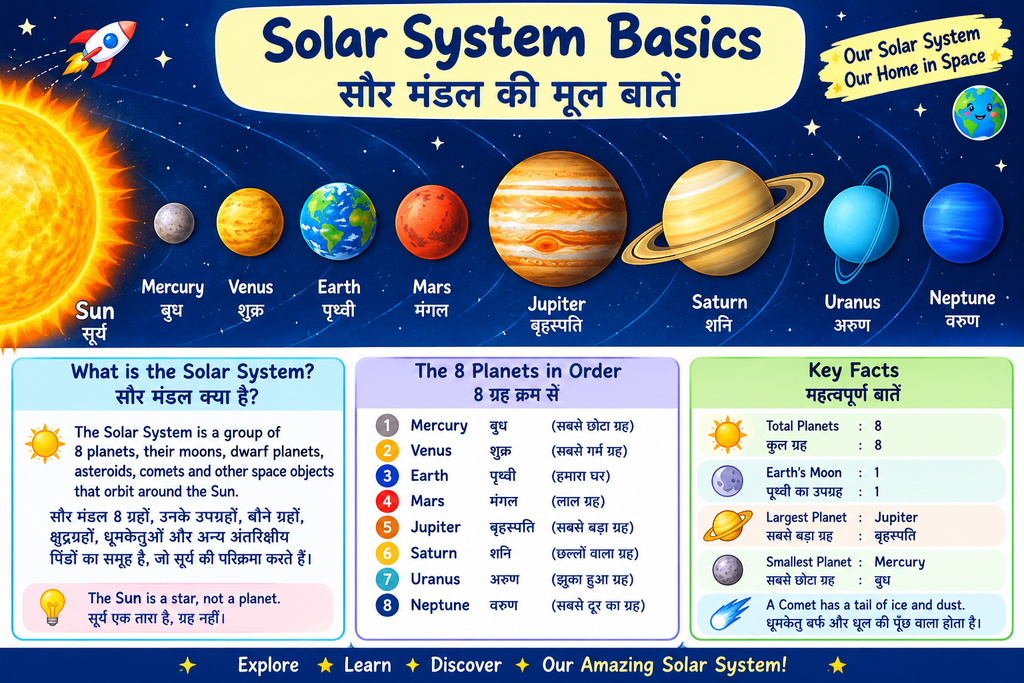
The Solar System (सौरमंडल) consists of the Sun at its center and all the celestial bodies bound to it by gravity, including 8 planets, their moons, dwarf planets, asteroids, and comets.
Key Definitions (मूल परिभाषाएँ)
- The Sun (सूर्य): The star at the center of our solar system, providing light and heat energy. (हमारे सौरमंडल के केंद्र में स्थित तारा, जो प्रकाश और ऊष्मा का मुख्य स्रोत है।)
- Planet (ग्रह): A large spherical celestial body that orbits a star and has cleared its orbital path. (एक बड़ा खगोलीय पिंड जो किसी तारे की परिक्रमा करता है।)
- Moon / Natural Satellite (उपग्रह): A celestial body orbiting a planet (e.g., Earth’s Moon). (किसी ग्रह की परिक्रमा करने वाला आकाशीय पिंड, जैसे चंद्रमा।)
The 8 Planets in Order from the Sun (सूर्य से दूरी के क्रम में 8 ग्रह)
| No. | Planet (English) | ग्रह (Hindi) | Key Feature / मुख्य विशेषता |
|---|---|---|---|
| 1 | Mercury | बुध | Smallest planet, closest to the Sun (सबसे छोटा और सूर्य के सबसे निकटतम ग्रह) |
| 2 | Venus | शुक्र | Hottest planet, “Morning/Evening Star” (सबसे गर्म ग्रह, ‘भोर का तारा’) |
| 3 | Earth | पृथ्वी | Only known planet with life, the “Blue Planet” (एकमात्र ज्ञात ग्रह जहाँ जीवन है, ‘नीला ग्रह’) |
| 4 | Mars | मंगल | The “Red Planet” due to iron oxide (आयरन ऑक्साइड के कारण ‘लाल ग्रह’) |
| 5 | Jupiter | बृहस्पति | Largest planet in the solar system (सौरमंडल का सबसे बड़ा ग्रह) |
| 6 | Saturn | शनि | Famous for its prominent ring system (अपने सुंदर वलयों/छल्लों के लिए प्रसिद्ध) |
| 7 | Uranus | अरुण | Ice giant that rotates on its side (बर्फ से बना विशाल ग्रह जो अपनी धुरी पर अत्यधिक झुका हुआ है) |
| 8 | Neptune | वरुण | Farthest major planet, cold and windy (सूर्य से सबसे दूर स्थित अत्यंत ठंडा और तूफानी ग्रह) |
Planet Categories (ग्रहों के प्रकार)
- Inner / Terrestrial Planets (आंतरिक / स्थलीय ग्रह): Mercury, Venus, Earth, Mars. They have solid, rocky surfaces. (बुध, शुक्र, पृथ्वी, मंगल — इनकी सतह ठोस और चट्टानी होती है।)
- Outer / Gas & Ice Giants (बाहरी / गैसीय ग्रह): Jupiter, Saturn, Uranus, Neptune. They are massive with thick atmospheres and no solid surface. (बृहस्पति, शनि, अरुण, वरुण — ये बहुत बड़े होते हैं और गैस व बर्फ से बने होते हैं।)
Other Members of the Solar System (अन्य प्रमुख खगोलीय पिंड)
- Dwarf Planets (बौने ग्रह): Smaller spherical bodies like Pluto (यम) that have not cleared their orbits.
- Asteroid Belt (क्षुद्रग्रह बेल्ट): A region of rocky debris orbiting between Mars and Jupiter (मंगल और बृहस्पति के बीच चट्टानी टुकड़ों की पेटी).
- Comets (धूमकेतु / पुच्छल तारे): Bodies of ice and dust that produce a glowing tail when approaching the Sun.